
What a daily sales call report should show
A walk through one day’s report for a three-person inside sales team, section by section, with what the sales manager does with each part the next morning.
Samples and orders open January 2027.
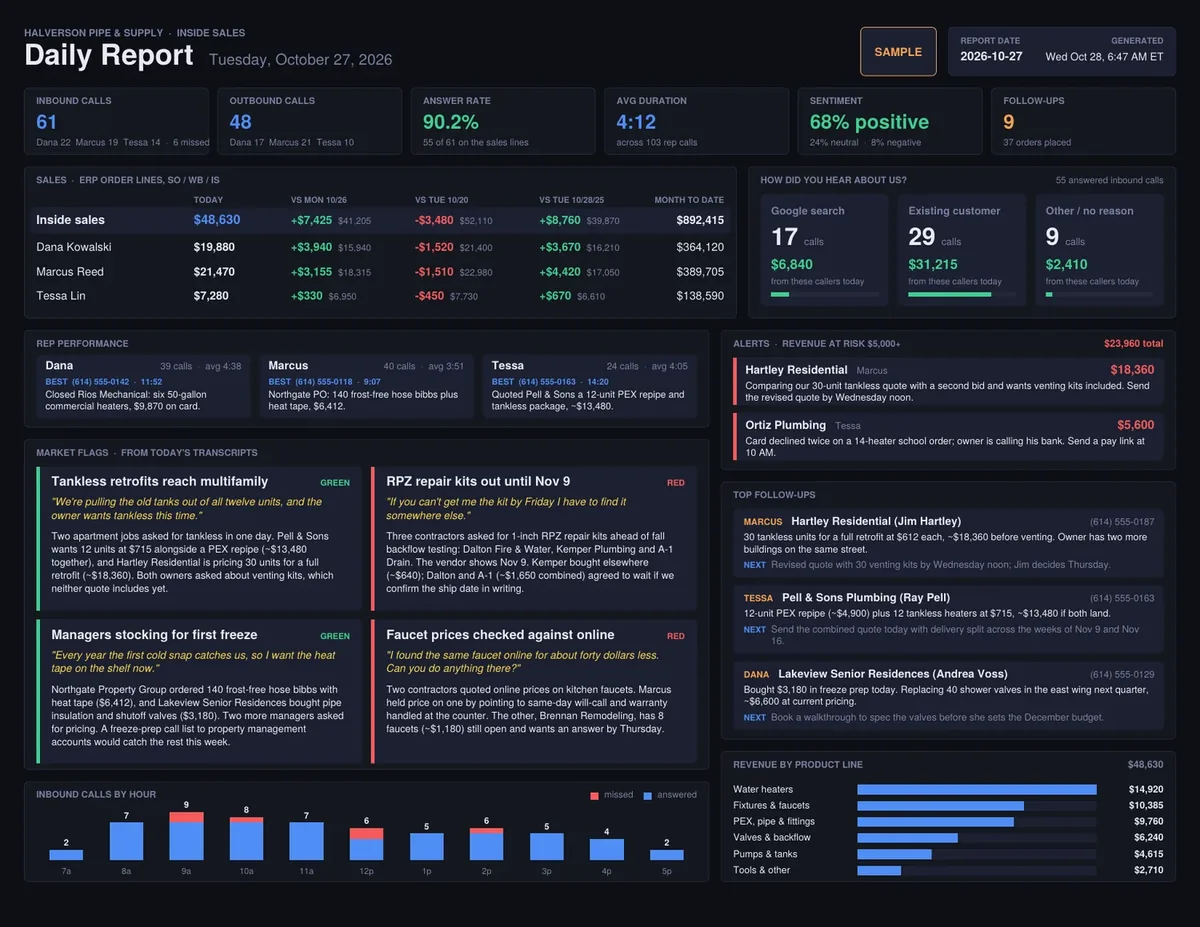
The example here is the distributor report on our sample reports page. Halverson Pipe & Supply is a fictional plumbing distributor in Columbus with three inside sales reps: Dana, Marcus and Tessa. The people and numbers are made up. The sections are the ones we would put in front of a real sales manager, in the order they read them.
Start with the day in six numbers
The top row answers one question: did the phones do their job yesterday? On the sample day the team took 61 inbound calls and made 48 outbound. Six inbound calls went unanswered, so 55 of 61 were picked up, a 90.2% answer rate. The average call ran about four minutes, and phone customers placed 37 orders.
Most days these numbers look like every other day, and the manager moves on in a few seconds. They earn their place at the top because the bad days stand out. If the answer rate drops to 80% or missed calls double, that shows up before anyone has opened the phone system.
Sales by rep, compared with the right day
Order lines from the ERP, by rep, with three comparisons:
| Yesterday | vs the day before | vs same weekday last week | vs same day last year | |
|---|---|---|---|---|
| Inside sales | $48,630 | +$7,425 | -$3,480 | +$8,760 |
| Dana | $19,880 | +$3,940 | -$1,520 | +$3,670 |
| Marcus | $21,470 | +$3,155 | -$1,510 | +$4,420 |
| Tessa | $7,280 | +$330 | -$450 | +$670 |
The same weekday last week is the comparison that matters most for a counter business. Mondays are busy, Fridays are quiet, and the first warm week of spring looks nothing like the week after. Comparing Tuesday with Monday alone would make almost every Tuesday look like a slump or a win.
This section only works if the sales figure comes from the system the business already trusts, the ERP or CRM, rather than from what reps type into a call log. When the call report and the sales system disagree, the manager stops reading the call report.
How callers found you, and what they bought
Of the 55 answered inbound calls, 17 came from people who found the business through a Google search, 29 were existing customers and 9 gave no reason. The search callers placed $6,840 in orders that day, existing customers $31,215.
One day of this means little. A month of it tells the owner what the search listing and the website are worth in orders, which is a number most small distributors never see.
Revenue at risk, with a name and a deadline
This is the section the manager acts on first. Two calls carried more than $5,000 at risk:
- Hartley Residential, $18,360 (Marcus). Comparing the 30-unit tankless quote with a second bid and wants venting kits included. Send the revised quote by Wednesday noon.
- Ortiz Plumbing, $5,600 (Tessa). Card declined twice on a 14-heater school order, and the owner is calling his bank. Send a pay link at 10 AM.
Each line has an account, a dollar figure, an owner and one next step with a time on it. Without the next step, a list like this becomes a worry list that nobody works.
What customers said, in their own words
Two or three themes from the day’s calls, each backed by a quote:
"We’re pulling the old tanks out of all twelve units, and the owner wants tankless this time."
"If you can’t get me the kit by Friday I have to find it somewhere else."
The first came from one of two apartment jobs that asked for tankless heaters on the same day, worth about $31,840 between them. Neither quote included venting kits, so that is the follow-up. The second came from one of three contractors asking for repair kits that are out of stock until November 9. One of them bought elsewhere. The other two agreed to wait if someone confirmed the ship date in writing.
A theme with quotes tells the manager something the order numbers can’t: what is about to sell, what is about to be lost, and which promise needs keeping.
Follow-ups for each rep
Every open promise from the day, under the rep who owns it, with the customer’s name, phone number, what was said and the next step. For example, Lakeview Senior Residences bought $3,180 in freeze prep and mentioned replacing 40 shower valves next quarter. The next step is to book a walkthrough before their December budget is set.
Missed calls by hour
A small chart of answered and missed calls by hour. On the sample day the misses were spread out. When they bunch up at lunch or the last hour of the day, the fix is usually a schedule change, and this chart is how the manager finds out.
What to leave out
A daily report gets read when it fits on a page and takes a few minutes. That means leaving things out:
- A list of every call. The manager needs the calls that need something, and the totals.
- Scores without a reason attached. "68% positive" is only useful next to the calls that weren’t.
- Anything that needs a meeting to explain.
Building one yourself
If you want to start by hand, our free sales call report template has the same columns in Excel and CSV, with example rows. Each rep fills in their totals and follow-ups at the end of the day, and the manager reads it the next morning.
If you’d rather have it written for you, that is what Morning Tally does: every business-day morning we read the previous day’s calls, match them to orders in your ERP or CRM, and email one page like this one. You can see all four sample reports before deciding.
Common questions
How long should a daily sales call report be?
One page for the daily report. If it runs longer, the manager stops reading it by the second week. Longer weekly or monthly reviews can carry the trends.
Who should get the daily report?
The sales manager and the owner, at minimum. Some teams also send each rep their own section so they see their follow-ups first thing.
Should the report include call recordings or full transcripts?
No. It should quote the few lines that matter and say what to do about them. Recordings and transcripts are for the rare call someone needs to go back to.
Get on the January list
Samples and orders open in January 2027. Tell us your company name and phone system, and we’ll put you on the list for the first free sample reports.
Join the January list